March 3, 2026
If you’ve ever tried planting a tree in Nashville, you know that Middle Tennessee’s heavy clay soil presents unique challenges. At The Good Tree Company, we’ve spent years helping local homeowners understand how Nashville’s soil composition impacts tree health and stability. This guide explains what you need to know to keep your trees thriving.
Understanding Nashville’s Clay Soil Composition
Nashville sits within the Highland Rim and Nashville Basin geological regions, where clay-heavy soil dominates the landscape. The USDA Natural Resources Conservation Service documents the characteristics of Tennessee’s clay-based soils, including the fragipan layers that restrict drainage and root growth. According to the Nashville Tree Conservation Corps, the area’s topsoil typically contains high clay and limestone content, formed over thousands of years from the underlying limestone bedrock.
Clay soil consists of extremely fine particles, measuring less than 0.002 millimeters in diameter. These tiny particles pack tightly together, creating dense soil that behaves very differently from sandy or loamy types. The Middle Tennessee region receives approximately 47 inches of rainfall annually, which interacts with clay soil in ways that significantly affect tree root development.
The Major Problems Clay Soil Creates for Trees
Poor Drainage and Waterlogging
Clay soil’s compact nature creates serious drainage issues. When clay particles pack together, water cannot move through the soil effectively. Instead of draining within hours, clay soil can remain saturated for days or even weeks after heavy rain.
This waterlogging creates an oxygen-deprived environment around tree roots. Research shows that tree roots need oxygen to function properly. When soil pores fill with water, oxygen cannot reach the roots, leading to:
- Root suffocation and decay
- Anaerobic conditions that encourage harmful bacteria
- Root rot diseases
- Wilting despite wet soil (a common paradox in clay soils)
Limited Oxygen Availability
Tree roots require consistent oxygen access for respiration, nutrient uptake, and tissue growth. According to Colorado State University Extension, heavy clays and soil compaction restrict water and oxygen uptake by roots and are among the biggest killers of urban trees. Studies indicate that roots need approximately 0.2 micrograms per square centimeter per minute of oxygen diffusion to sustain healthy growth.
In compacted clay soil, oxygen penetrates only about 2 inches deep, while uncompacted soil allows oxygen to reach 6 inches or more. This forces roots to grow near the surface where oxygen is available, creating shallow root systems that compromise tree stability.
Soil Compaction Challenges
Clay soils compact easily, especially when walked on, driven over, or worked while wet. Compaction squeezes out air spaces between soil particles, creating even denser soil that:
- Restricts root expansion and penetration
- Reduces water infiltration
- Limits nutrient availability
- Increases surface runoff during storms
Urban Nashville trees face additional compaction from construction, foot traffic, and heavy equipment, making soil conditions even more challenging.
Extreme Moisture Swings
Clay soil swings between two problematic extremes. When saturated, it holds excessive water. When dry, it becomes rock-hard and develops surface crusts that resist water penetration. Water runs off instead of soaking in, leaving roots dry and stressed beneath the hardened surface.
How Clay Soil Weakens Tree Stability
Shallow Root System Development
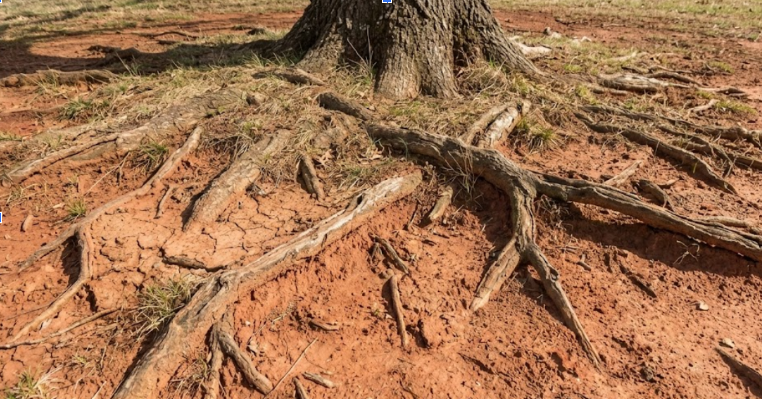
When clay soil restricts deep root growth, trees develop plate-like root systems near the surface. According to tree stability research, trees with shallow root systems are significantly more vulnerable to wind damage than those with deep, anchored roots.
Approximately 90 to 95 percent of tree roots naturally grow within the top three feet of soil. However, in heavy clay, most roots concentrate in just the top 12 inches where oxygen is accessible. This shallow rooting pattern means:
- Less structural support for the tree
- Reduced ability to withstand wind forces
- Higher risk of toppling during storms
- Poor anchoring into stable soil layers
Increased Wind Throw Risk
Wind throw, or uprooting, occurs when wind forces overcome a tree’s anchoring strength. Soil saturation dramatically increases wind throw probability. When clay soil becomes waterlogged, it loses its holding capacity, essentially turning into a thick mud that cannot support the tree’s weight during high winds.
Trees with shallow roots in saturated clay soil have roughly twice the likelihood of pulling out of the ground during storms compared to trees with properly developed root systems in well-drained soil.
Structural Instability
The combination of shallow roots and poor soil conditions creates structurally unstable trees. Without deep vertical roots acting as anchors, trees rely solely on lateral roots near the surface. This configuration provides minimal resistance to the rotational forces that occur during strong winds.
Tree Species Most Affected by Clay Soil
Not all trees respond the same way to Nashville’s clay conditions. Some species struggle significantly, while others show remarkable tolerance.
Trees That Struggle in Clay
| Tree Species | Primary Issues |
| White Pine | Dies quickly in clay. Needs deep, well-drained soil. |
| Dogwood | Susceptible to anthracnose and root problems in poorly drained soil. |
| Japanese Maple | Sensitive to waterlogged conditions and soil compaction. |
| Ash Trees | Shallow roots combined with pest pressure create multiple risks. |
| River Birch | Despite moisture tolerance, it struggles in dense, compacted clay soil. |
Trees That Tolerate Clay Soil
According to local arborists and the Nashville Tree Conservation Corps, these species perform well in clay conditions:
Oak Species
- Willow Oak: Fast-growing with clay tolerance
- White Oak: Thrives in moist, slightly acidic clay soils
- Pin Oak: Adapts to various moisture levels
Maple Varieties
- Red Maple: Excellent clay tolerance and adaptability
- Silver Maple: Handles wet conditions well
- Sugar Maple: Tolerates clay when established
Other Clay-Tolerant Trees
- Bald Cypress: Excellent for wet clay areas
- Tulip Poplar (Tennessee’s state tree): Handles various soil types
- Black Gum: Prefers wet clay soils
- Eastern Redbud: Adapts to clay with proper care
- Crabapple: Thrives in moisture-retentive soils
- Elm: Shows good clay tolerance
- Honeylocust: Extremely adaptable to compaction and clay
Identifying Clay Soil Problems in Your Yard
Visual Signs
Watch for these indicators of clay soil issues:
- Standing water or puddles that persist for more than 24 hours after rain
- Hard, cracked soil surface during dry periods
- Soil that forms sticky balls when wet
- Roots growing on or very near the soil surface
- Exposed roots that weren’t visible previously
Tree Health Symptoms
Trees struggling with clay soil conditions display specific symptoms:
- Yellowing leaves (chlorosis) despite adequate fertilization
- Stunted growth or a smaller-than-expected canopy
- Premature leaf drop in late summer
- Thinning canopy or branch dieback
- Leaning trunk or exposure of the root ball
- Brown leaf edges indicate root stress
- Wilting even when the soil appears moist
Simple Soil Tests
Conduct a basic assessment:
- Texture Test: Squeeze moist soil in your hand. If it forms a sticky ball that holds its shape and feels smooth, you have clay soil.
- Percolation Test: Dig a hole 12 inches deep, fill it with water, and let it drain. Fill again and measure drainage after one hour. If less than one inch drains per hour, you have poor drainage.
- Compaction Check: Try pushing a screwdriver or soil probe into moist (not wet) soil. If you cannot push it in at least 6 inches with moderate pressure, the soil is compacted.
Solutions for Improving Clay Soil
Organic Matter Addition
Adding organic material is the most effective long-term solution for clay soil. Work 1 to 4 inches of compost, well-aged manure, or leaf mold into the top 6 to 8 inches of soil annually.
Benefits include:
- Breaking up clay particles into larger aggregates
- Creating larger pore spaces for air and water movement
- Improving drainage while maintaining moisture retention
- Attracting earthworms and beneficial microorganisms
- Adding nutrients gradually as organic matter decomposes
Important: Spread amendments over the entire planting area, not just individual holes. Amending only the planting hole creates a “bathtub effect” where roots stay confined and water accumulates.
Mulching Strategies
Apply 3 to 4 inches of arborist wood chips, pine bark, or shredded leaves around tree bases, extending out to the dripline. Keep mulch 2 to 3 inches away from the trunk to prevent rot.
Mulch provides multiple benefits:
- Regulates soil temperature
- Retains moisture during dry periods
- Prevents surface crusting
- Gradually breaks down to improve soil structure
- Reduces compaction from foot traffic
- Adds organic matter over time
Aeration Techniques
For established trees, careful aeration helps oxygen reach roots:
- Use a broadfork or an aeration tool to create holes in compacted soil
- Work radially from the trunk outward, staying beyond the dripline when possible
- Avoid damaging large roots
- Conduct aeration during the dormant season
- Fill holes with compost to maintain an improved structure
Proper Watering Practices
Water deeply but infrequently to encourage deep root growth:
- Apply 1 to 2 inches of water per week during the growing season
- Water every 7 to 10 days rather than daily shallow watering
- Use drip irrigation or soaker hoses to deliver water slowly
- Allow soil to dry slightly between waterings
- Reduce watering when the soil feels saturated 6 inches below the surface
Best Planting Practices for Clay Soil
Site Preparation
Before planting, prepare the area properly:
- Test soil drainage using the percolation method
- Amend a large planting area (minimum 3 times the root ball diameter)
- Avoid planting in low spots where water collects
- Consider raised beds or mounded planting for poor drainage areas
Correct Planting Depth
This is critical in clay soil:
- Dig a hole no deeper than the root ball height
- Make the hole 2 to 3 times wider than the root ball
- Plant with the root flare 2 to 3 inches above the surrounding soil grade
- Create a saucer-shaped hole rather than a vertical-sided one
- Rough up the hole sides to prevent glazing and root circling
Backfill Methods
- Use native soil for backfilling (do not over-amend)
- Mix in 25 to 30 percent compost with the removed soil
- Break up soil clumps thoroughly
- Ensure good soil-to-root contact
- Water thoroughly while backfilling to eliminate air pockets
- Compact soil gently but firmly around the root ball
Post-Planting Care
Newly planted trees in clay soil need special attention:
- Water the day of planting and the day after
- Water again three days later, then every three to four days for the first month
- Reduce to weekly watering after establishment
- Monitor soil moisture at root depth, not just surface
- Apply mulch after planting
- Avoid fertilizing for the first year
Long-Term Tree Care in Clay Soil
Annual Maintenance
Implement these practices yearly:
- Add 1 to 2 inches of compost as a top dressing around trees
- Refresh mulch layers to maintain a 3 to 4 inch depth
- Monitor for signs of compaction or poor drainage
- Conduct soil tests every 2 to 3 years
- Inspect roots for surface growth patterns
Avoiding Additional Compaction
Protect existing root zones:
- Keep vehicles and heavy equipment away from tree drip lines
- Use temporary fencing during construction
- Create designated walking paths
- Avoid tilling or digging near established trees
- Do not add more than 1 inch of soil over existing root zones
Drainage Improvements
For persistent drainage issues:
- Install French drains to redirect water away from trees
- Create shallow swales to channel water
- Grade the soil to eliminate low spots
- Consider a professional drainage assessment for severe cases
Note: Avoid adding gravel below trees as this creates a perched water table that worsens drainage problems.
When to Call a Professional Arborist
Contact a certified arborist if you notice:
- Significant tree leaning (more than 15 degrees from vertical)
- Large sections of exposed root ball
- Extensive canopy dieback (more than 25 percent)
- Mushrooms or fungal growth at the tree base
- Soil that remains saturated for weeks
- Multiple trees showing decline symptoms
- Recent construction near valuable trees
Professional services include:
- Comprehensive soil testing and analysis
- Root zone aeration and decompaction
- Structural support systems for unstable trees
- Custom soil amendment programs
- Drainage system installation
- Risk assessment for potentially dangerous trees
Frequently Asked Questions
Why do tree roots grow on the surface in clay soil?
Tree roots grow toward the surface in clay soil primarily to access oxygen. Dense, compacted clay lacks adequate air pores deeper in the soil profile. Since roots require oxygen for respiration and nutrient uptake, they concentrate in the top few inches where oxygen from the atmosphere can penetrate. Compaction, poor drainage, and waterlogging all force roots upward where they can breathe.
Can I cut surface roots without harming my tree?
Cutting surface roots is strongly discouraged as it significantly weakens tree stability and health. Removing roots eliminates thousands of tiny feeder roots, damages the tree’s ability to absorb water and nutrients, creates entry points for diseases and pests, and dramatically increases the risk of the tree falling during storms.
How long does it take to improve clay soil?
Improving clay soil is a gradual process that typically takes 2 to 5 years of consistent effort. You will see some improvements within the first growing season after adding organic matter, but significant structural changes require several years of annual compost additions and mulching.
What is the bathtub effect when planting trees?
The bathtub effect occurs when you dig a hole in clay soil and fill it with amended, loose soil. The surrounding clay acts like a bathtub or pot, preventing roots from spreading beyond the planting hole. Water accumulates in the amended area because it cannot drain through the surrounding clay walls.
Should I use sand to improve clay soil drainage?
Adding sand to clay soil is generally not recommended unless you add very large quantities (at least 50 percent by volume). Small amounts of sand mixed with clay can actually create a concrete-like substance that is worse than pure clay. Instead, focus on adding organic matter like compost, which effectively improves both drainage and soil structure without the risks associated with sand. Organic amendments also provide nutrients and encourage beneficial soil organisms.
How deep do tree roots grow in clay soil?
In Nashville’s clay soil, most tree roots grow within the top 12 to 18 inches, with the majority concentrated in the upper 6 to 12 inches. This is much shallower than in loamy or sandy soils, where roots can extend 3 feet or deeper. The shallow rooting occurs because the clay’s compact nature and poor oxygen availability prevent roots from penetrating deeper layers.
What trees should I avoid planting in Nashville clay soil?
Avoid planting white pine, which requires deep, well-drained soil and typically dies quickly in clay. Japanese maples are very sensitive to waterlogged conditions. Certain dogwood varieties struggle with the combination of poor drainage and disease pressure. Ash trees face challenges from both shallow rooting in clay and pest problems.
How often should I water trees in clay soil?
Water trees in clay soil deeply but infrequently. Provide 1 to 2 inches of water per week during the growing season, delivered in one or two deep watering sessions rather than daily light watering. In Nashville’s climate, this typically means watering every 7 to 10 days during dry periods. Always check soil moisture 4 to 6 inches below the surface before watering.
Can raised beds solve clay soil problems?
Raised beds effectively solve many clay soil challenges by elevating roots above problematic drainage issues. Build beds 8 to 12 inches high using a mixture of native topsoil, compost, and sand if desired. This creates better drainage and aeration while still encouraging roots to eventually grow into the surrounding soil.
How do I know if my tree is at risk of falling?
Warning signs of instability include visible leaning (especially recent changes), large sections of exposed root ball at the soil surface, cracks in the soil radiating from the trunk, mushrooms or fungal growths at the tree base, extensive dead branches or canopy dieback, soil that remains waterlogged for extended periods, and the tree moving or rocking during moderate winds.
Trusted Nashville Arborists for Clay Soil Tree Care
The Good Tree Company serves Nashville and surrounding communities with expert tree care services designed specifically for Middle Tennessee’s challenging soil conditions. Our certified arborists understand how Nashville’s clay soil affects tree health and stability. We provide comprehensive soil assessment, tree planting, health care programs, and stability evaluations to help your trees thrive for generations. Contact us today for a professional consultation.