
May 12, 2026
If you have a leaning oak over your garage or a dying pine near power lines, “tree removal” can feel like a stressful word. Many homeowners imagine a lumberjack yelling “Timber!” as a tree crashes down, but in a professional residential setting, that is exactly what we avoid.
Tree removal isn’t an event – it’s a highly engineered dismantling process. Below is a behind-the-scenes look at how certified arborists safely remove trees from tight spaces, protect your landscaping, and ensure your property stays damage-free.
Key Takeaways
- Precision over Power: Most trees are removed in small, controlled sections from the top down.
- Rigging is Key: We use specialized ropes and pulleys to “float” heavy logs away from your roof.
- Safety First: A “Site Walk” is the most important 15 minutes of the entire job.
- Active Cleanup: A pro crew cleans as they go, so your yard isn’t a disaster zone mid-project.
Step 1: The Safety Audit (The Most Critical Phase)
Before any cutting begins, a crew lead performs a site risk assessment, a standard practice aligned with industry safety guidelines from the International Society of Arboriculture and ANSI A300 standards. We aren’t just looking at the tree; we are looking at the “hidden” variables:
- The Lean and the Load: Which way does the weight naturally want to go?
- Target Zones: Identifying “exclusion zones” where no people or pets are allowed.
- Structural Integrity: Is the trunk hollow? Is the ground soft from recent rain?
- Utility Lines: Confirming clearance from power and gas lines.
Pro Tip: If a crew arrives and starts cutting without a 10-minute huddle or walk-around, that’s a red flag. Safety planning prevents 99% of property damage.
Step 2: Canopy Dismantling (Working Top-Down)
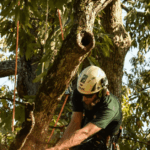
In the industry, we call this sectional removal. Instead of felling the tree whole, an arborist climbs the tree (or uses a bucket truck) to remove the outer branches first.
By removing the “sail” (the leafy canopy), we reduce the wind resistance and weight before tackling the heavy wood. In tight quarters, we use rigging systems, heavy-duty ropes, and friction devices to lower limbs slowly so they don’t dent your lawn or crack your driveway.
Step 3: Managing the “Center of Gravity”
As the tree gets smaller, its physics change. A tree that was stable ten minutes ago can become “shaky” once the weight is redistributed.
Professional crews constantly adjust. We use field-tested cutting techniques (like the open-face notch or the bore cut) to ensure every piece falls exactly where we want it. As noted in national safety standards, improper cuts are the leading cause of “barber-chairing,” where a trunk splits vertically and kicks back an arborist’s worst nightmare.
Step 4: Trunk Sectioning & Controlled Drops
Once the branches are gone, we are left with the “stick” (the main trunk). We cut this into manageable “rounds.”
- In open yards: These are dropped into a bed of woodchips to cushion the impact.
- Near structures: Each log is tied off and lowered via a “Port-a-Wrap” to ensure a soft landing.
Step 5: The “Clean-As-You-Go” Rule
A common myth is that cleanup happens at the end. In reality, a professional crew has a “ground person” who immediately moves brush to the chipper while the climber is still working. This keeps the workspace clear of tripping hazards and ensures that by the time the final log is cut, your yard is already looking normal again.
Step 6: Stump Management & Final Walkthrough
What’s left? Usually, a stump is cut as flush to the ground as possible. Depending on your contract, you might choose:
- Stump Grinding: Shaving the wood down 6-12 inches below the soil.
- Full Removal: Only recommended in specific construction scenarios.
Before the trucks pull away, a reputable company will do a Final Walkthrough with you to ensure every gate is closed, every branch is raked, and no shingles are nicked.
Frequently Asked Questions
How do I know if my tree actually needs to be removed?
A tree usually needs removal if it’s dead, structurally unstable, or posing a risk to people or property. Warning signs include heavy leaning, large dead branches, visible trunk decay, root lifting, or damage from storms. A certified arborist can confirm whether removal is necessary or if pruning is a safer alternative.
Why can’t a professional just cut the tree down in one piece?
Most residential trees are too close to homes, fences, or power lines to be safely felled whole. Sectional removal allows arborists to control each cut section, reducing unpredictable falls and damage, a method commonly used in urban forestry where space constraints prevent full tree felling. This method prioritizes safety over speed.
What happens if my tree is near power lines?
Trees near power lines require special planning and coordination. Arborists adjust their rigging and cutting strategy to maintain safe clearance, and in some cases, the utility company may need to be involved. This is one situation where DIY work is especially dangerous and strongly discouraged.
Will you need to bring heavy equipment into my yard?
Not always. Smaller or more accessible trees may only require climbing gear and ropes. Larger or high-risk removals might involve bucket trucks, cranes, or chippers, but professionals use ground protection mats to minimize lawn and soil damage.
What is “barber-chairing,” and why is it dangerous?
Barber-chairing happens when a trunk splits vertically during a cut, causing the tree to kick back violently. It’s one of the most dangerous failures in tree removal and usually results from improper cutting techniques or hidden internal decay. Certified arborists use specific cuts to prevent this.
Do you remove the tree stump automatically?
Stump removal is usually a separate service unless specified in the contract. Most homeowners choose stump grinding, which removes the visible stump and part of the root system below ground. Full removal is typically only needed for construction or hardscaping projects.
What happens to the wood and debris after removal?
All branches and debris are typically chipped, hauled away, or recycled unless you request to keep the wood for firewood or mulch. Professional crews clean as they go, so debris doesn’t pile up during the job. Final cleanup is part of the service.
Is tree removal affected by weather or season?
Yes, weather conditions can impact scheduling and safety. Wet soil, high winds, or storms may delay removal to prevent equipment damage or accidents. However, most trees can be safely removed year-round with proper planning.
How can I tell if a tree removal company is reputable?
Look for proper licensing, insurance, and certification by organizations like the ISA. A reputable company will perform a site walk, explain the process clearly, and never rush into cutting without safety planning. Transparency and communication are key indicators of professionalism.
Reviewed by a Certified Arborist
This safety analysis has been reviewed by an ISA Certified Arborist to ensure all information regarding soil mechanics and tree failure meets the standards of the International Society of Arboriculture.